
Local SEO best practices are the actions businesses can take to improve their visibility in Google Maps, the Local Pack, and local organic search results. The most important areas include optimizing your Google Business Profile, keeping business information accurate, earning genuine customer reviews, creating locally relevant website content, building trusted local citations, and maintaining a strong technical SEO foundation.
For businesses that depend on customers from a specific city, region, or service area, local search visibility can directly influence website visits, phone calls, enquiries, bookings, and store visits. When someone searches for a nearby product or service, businesses that appear prominently in Google's local results have an important opportunity to reach that customer before a competitor does.
However, Local SEO is more than adding a location to your homepage or creating a Google Business Profile. A sustainable strategy combines your Business Profile, website, reputation, business information, local relevance, technical performance, and overall online presence.
In this guide, you'll learn 15 practical Local SEO best practices you can use to strengthen your local search presence. We'll explain what each practice involves, why it matters, how to implement it, and which mistakes to avoid.
Quick Answer: What Are Local SEO Best Practices?
Local SEO best practices are proven methods for improving a business's visibility in location-based search results. They include optimizing your Google Business Profile, maintaining accurate business information, earning genuine reviews, targeting relevant local searches, creating useful location-specific content, building relevant citations and links, improving website usability, and monitoring local search performance.
The goal isn't to manipulate Google's rankings. It is to make your business easier for search engines and customers to understand, trust, and find when your products or services are relevant to a local search.
Key Takeaways
- Optimize your Google Business Profile with complete, accurate, and relevant information.
- Keep your business information consistent across your website, directories, and other trusted sources.
- Earn genuine customer reviews and respond to feedback professionally.
- Use local keywords naturally to communicate your services and geographic relevance.
- Create genuinely useful local content instead of producing thin pages for every nearby city.
- Strengthen your website's technical foundation so search engines and users can access and understand your content.
- Track your performance and improve continuously rather than treating Local SEO as a one-time task.
Table of Contents
- What Is Local SEO?
- Why Local SEO Matters
- How Google Ranks Local Businesses
- 15 Local SEO Best Practices
- Common Local SEO Mistakes
- Local SEO Checklist
- Frequently Asked Questions
- Final Thoughts
What Is Local SEO?
Local SEO (Local Search Engine Optimization) is the process of improving a business's online presence so it can become more visible when people search for products or services in a specific geographic area.
Traditional SEO can target audiences across an entire country or even globally. Local SEO focuses more specifically on searches where location or proximity is relevant to the customer's decision.
Examples include searches such as:
- "dentist near me"
- "best coffee shop in Manila"
- "plumber in Melbourne"
- "SEO agency in the Philippines"
- "flower delivery in Cebu"
These searches can produce several types of local results, including Google Maps listings, the Local Pack, Google Business Profiles, and localized organic website results.
If you're new to the subject, you can also explore our guide on Local SEO vs. National SEO to understand how geographic targeting changes an SEO strategy.
Local SEO vs. Traditional SEO
| Local SEO | Traditional SEO |
|---|---|
| Targets customers in specific geographic markets. | Can target national or global audiences. |
| Places strong emphasis on local search and Google Maps visibility. | Focuses primarily on broader organic search visibility. |
| Uses local relevance and business-location signals. | Often targets broader industry or topic-based searches. |
| Google Business Profile can play an important role. | Website content and broader authority may be more central. |
Local SEO shouldn't be treated as a separate activity that only involves Google Maps. Your Business Profile, website, content, reviews, citations, technical SEO, and reputation work together to create a stronger local search presence.
Why Local SEO Matters for Businesses
Local search helps connect businesses with people who are actively looking for nearby products and services. A person searching for a dentist, restaurant, contractor, lawyer, florist, or marketing agency often has a much clearer commercial need than someone conducting a general informational search.
That makes local visibility particularly valuable for businesses that depend on geographically relevant customers.
If you want a deeper explanation of the business case, see our guide on why small businesses need Local SEO. It explores the role local search can play in visibility, customer discovery, and long-term business growth.
What Local SEO Can Help Businesses Achieve
- Increase visibility in Google Maps and local search.
- Reach customers actively searching for relevant products or services.
- Generate more qualified website visits.
- Increase calls, enquiries, bookings, or store visits.
- Build trust through authentic customer reviews and accurate business information.
- Create a stronger long-term search presence in the markets the business actually serves.
For businesses competing in crowded local markets, the goal isn't simply to appear somewhere in search results. The goal is to make your business the most relevant and useful option for the customers you want to reach.
Start by checking your Google Business Profile, website, and major business listings. Make sure your business name, address, phone number, website, and opening hours are accurate. Fixing obvious inconsistencies is a simple first step before moving into more advanced Local SEO work.
How Google Ranks Local Businesses
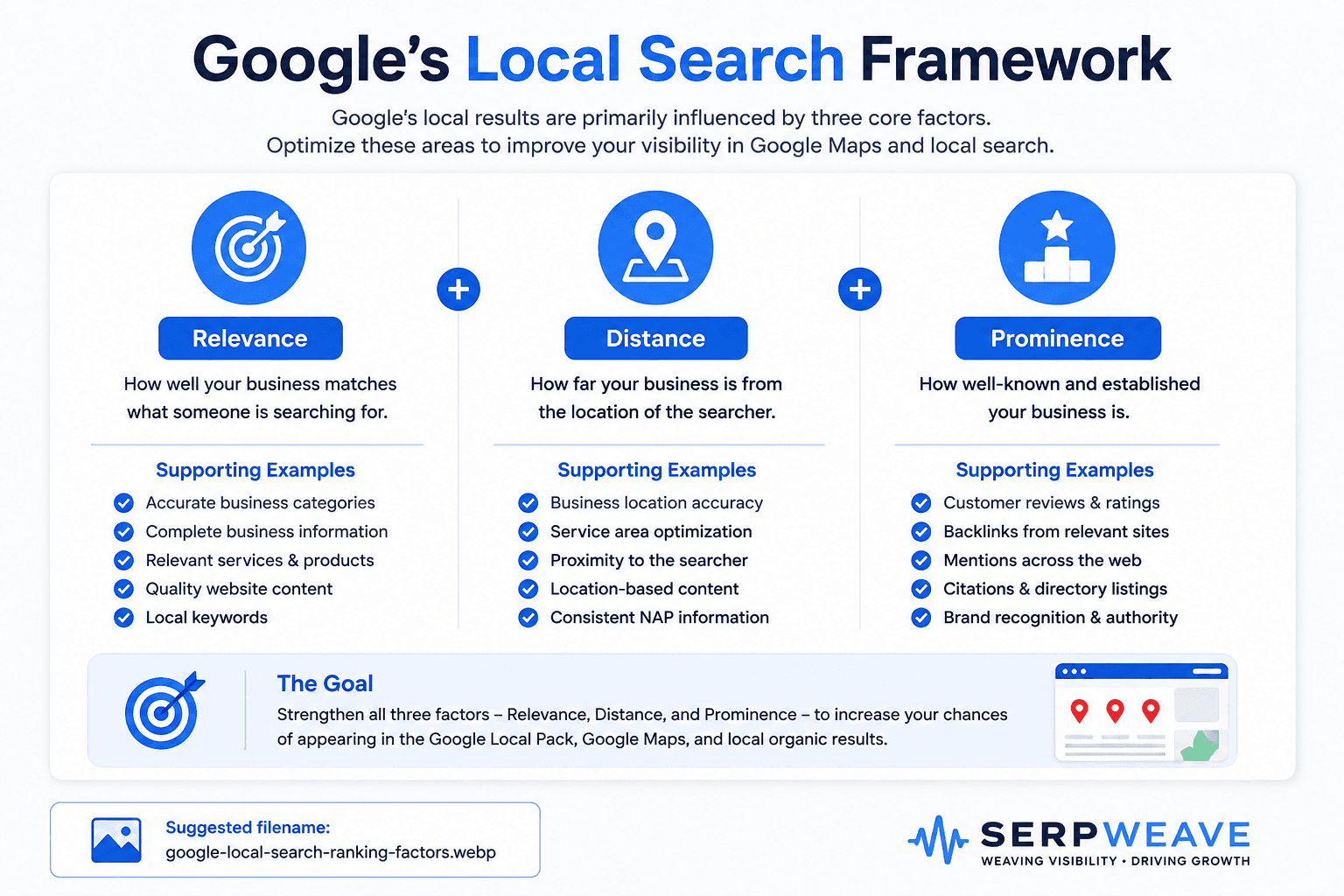
Google explains that local results are primarily influenced by relevance, distance, and prominence. These concepts provide a useful framework for understanding why one business may appear more prominently than another for a local search.
1. Relevance
Relevance refers to how well a business matches what someone is searching for. Accurate Business Profile information, appropriate categories, relevant services, and useful website content can help Google understand what a business offers.
The better your online presence communicates the actual products or services you provide, the easier it is for search engines and customers to determine whether your business is relevant to a particular search.
2. Distance
Distance refers to how far a business is from the location associated with a search. This can be the searcher's location or a location included in the query.
Businesses cannot control where a searcher is located, but they can make sure their actual business location or legitimate service area is accurately represented online.
3. Prominence
Prominence relates to how well-known and established a business is. Google considers various signals when determining prominence, including information it can find about the business across the web.
Reviews, links, mentions, citations, and the overall online presence of a business can contribute to how prominently that business is represented online.
| Local SEO Area | What to Focus On |
|---|---|
| Relevance | Accurate categories, services, website content, and business information |
| Distance | Accurate location or legitimate service-area information |
| Prominence | Reviews, mentions, links, citations, and overall business visibility |
Local SEO Is More Than Google Maps
Google Maps visibility is important, but it is only one part of a broader local search strategy. Your website also needs to communicate your services clearly, provide a useful experience, and support the information presented through your Business Profile and other online sources.
This is where on-page and semantic SEO can complement Local SEO. Optimizing titles, headings, internal links, content relevance, and search intent helps your website communicate its subject matter more effectively.
Likewise, technical issues can prevent otherwise useful content from performing as well as it should. A strong technical SEO foundation supports crawlability, indexing, structured data, website performance, and overall search accessibility.
Once these foundations are in place, businesses can build on them with the specific Local SEO practices covered in the next section.
15 Local SEO Best Practices
The following practices are designed to work together rather than as isolated ranking tricks. Start with the fundamentals, prioritize the areas most relevant to your business, and measure what changes over time.
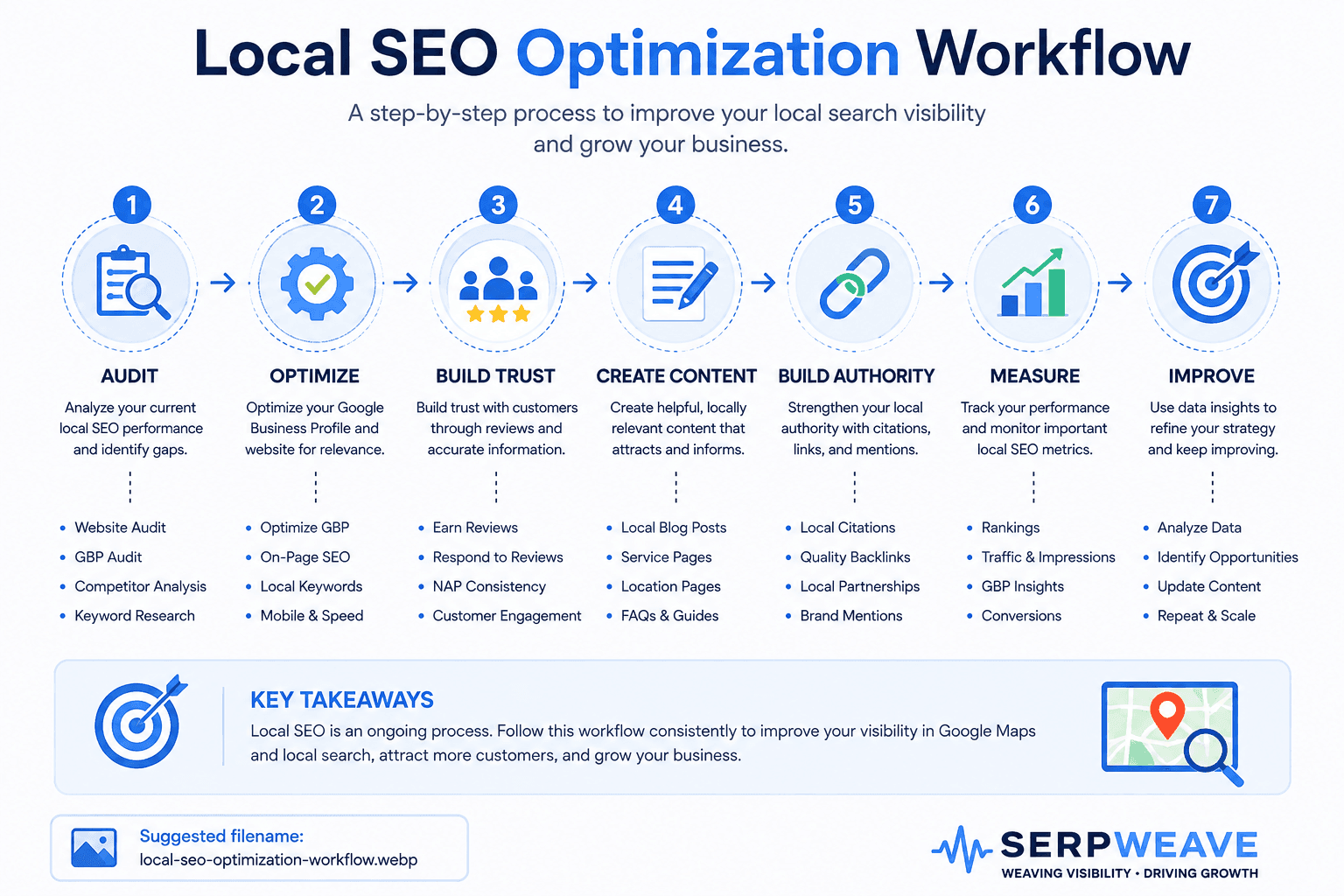
15 Local SEO Best Practices That Actually Improve Local Visibility
There is no single Local SEO tactic that guarantees a top position in Google. Strong local visibility comes from several elements working together: accurate business information, relevant content, a well-maintained Google Business Profile, positive customer experiences, a technically sound website, and credible signals from across the web.
The following Local SEO best practices focus on actions businesses can realistically implement and maintain over time. If you're starting from scratch, work through them in order. If your business already has a Local SEO foundation, use the list as an optimization and audit framework.
1. Fully Optimize Your Google Business Profile
Your Google Business Profile (GBP) is one of the most important assets in a local search strategy. It gives Google and potential customers information about your business, including what you offer, where you operate, when you're open, and how customers can contact you.
Start by making sure the profile accurately represents your real-world business. Review your:
- Business name
- Primary category
- Additional relevant categories
- Business address or service area
- Phone number
- Website URL
- Opening hours
- Services
- Business description
- Photos
Don't stop at completing the initial setup. Check the profile periodically for outdated information, incorrect hours, missing services, or changes to the business.
SERPWeave also has a dedicated guide covering Google Business Profile optimization if you want a deeper walkthrough of the profile itself.
Your Business Profile should be treated as an active business asset rather than a one-time SEO setup. Accurate information helps customers make decisions and gives search engines clearer information about your business.
Common mistake: Adding keywords to your business name that are not actually part of the business's real-world name. Your profile should accurately represent the business rather than being written solely to target search terms.
2. Keep Your Business Information Consistent
Local businesses are represented across many places online: their website, Google Business Profile, directories, industry websites, social profiles, review platforms, and local organizations.
Make sure important business details remain accurate across these sources, especially your:
- Business name
- Address
- Phone number
- Website
- Opening hours
SEO professionals often refer to the name, address, and phone information as NAP.
Google gathers business information from multiple sources, so maintaining accurate information throughout the web is good practice for both search engines and customers.
| Information | What to Check |
|---|---|
| Business name | Matches the actual business name |
| Address | Accurate and current |
| Phone number | Current and usable |
| Website | Points to the correct website |
| Opening hours | Reflects current regular and special hours |
Common mistake: Assuming an old directory listing doesn't matter simply because customers rarely visit it. Outdated information can create confusion for customers and make your overall business presence harder to manage.
3. Build a Consistent System for Earning Genuine Reviews
Reviews are valuable because they influence how potential customers perceive your business and can also contribute to local search visibility. Google states that reviews can help businesses stand out and that the number of reviews and positive ratings can influence local ranking.
The key word is genuine.
Don't buy reviews, manufacture customer experiences, or offer incentives in exchange for positive feedback. Instead, create a simple process that makes it easy for real customers to leave honest reviews after a genuine interaction with your business.
A simple review process can look like this:
- Deliver the service or complete the purchase.
- Follow up with the customer.
- Politely request honest feedback.
- Provide a convenient review link.
- Respond professionally to the review.
You can request reviews after completed projects, appointments, purchases, or other meaningful customer interactions.
Also pay attention to negative reviews. A thoughtful response can demonstrate that your business listens to customers and takes feedback seriously.
Create one standard review-request message your team can use after completed services. Keep it simple, polite, and focused on honest customer feedback.
Common mistake: Asking every customer for a five-star review. Instead, ask for an honest review and focus on delivering an experience worth talking about.
4. Choose the Most Accurate Business Category
Your Google Business Profile category helps Google understand what your business does. Choosing the most accurate primary category is therefore an important part of your Local SEO foundation.
Your primary category should describe the core business rather than simply being a keyword you want to rank for.
When choosing categories:
- Select the category that best represents your primary business.
- Add additional categories only when they genuinely describe relevant parts of the business.
- Avoid unrelated categories simply because they contain attractive keywords.
- Review your categories when your business changes significantly.
For example, a dental clinic should select an appropriate dental category rather than choosing unrelated healthcare categories simply to increase its potential search coverage.
Common mistake: Selecting categories based on search volume instead of business relevance.
5. Use Local Keywords Naturally
Your website should make it obvious what your business offers and where it operates. Local keywords can help communicate that information, but they should always be used naturally.
For example, a business serving Cebu might naturally use phrases such as:
- SEO services in Cebu
- Local SEO services in Cebu
- SEO consultant for Cebu businesses
- Google Business Profile optimization in Cebu
The exact terminology should reflect how your customers actually describe your products or services.
Useful places for local relevance include:
- Page titles
- H1 and relevant H2 headings
- Introductory content
- Service descriptions
- Location information
- Internal links
- Helpful FAQs
- Image alt text when it accurately describes the image
For a deeper look at optimizing content, you can naturally connect this practice with SERPWeave's On-Page & Semantic SEO service.
Common mistake: Repeating a city name in every sentence. Local relevance should make the page clearer, not make the content sound unnatural.
6. Create Useful Location-Specific Pages
If your business genuinely serves multiple cities or geographic areas, location-specific pages can help organize information around those markets.
But creating a page for every nearby city isn't automatically a good strategy.
A useful location page should contain information that genuinely helps customers in that location. Depending on the business, this might include:
- Services available in the area
- Specific service information
- Local customer questions
- Relevant projects or examples
- Service-area information
- Directions or location details
- Unique FAQs
- Useful internal links
For businesses with multiple physical locations, each location page should provide meaningful information about that specific branch.
For service-area businesses, only target locations the business legitimately serves.
Common mistake: Creating dozens of nearly identical city pages where only the city name changes. These pages often provide little additional value to users.
7. Build and Maintain Relevant Local Citations
A local citation is a mention of your business information on another website or platform. Citations can appear on business directories, industry websites, local organizations, chambers of commerce, professional associations, and other relevant sources.
Good citation building is not about collecting as many listings as possible. It is about ensuring that your business can be accurately discovered and referenced across relevant parts of the web.
Prioritize relevant sources such as:
- Local business directories
- Industry-specific directories
- Professional associations
- Chambers of commerce
- Local organizations
- Reputable business directories
Before creating a listing, consider whether the website is legitimate, relevant to your business, and useful to potential customers.
Think of citations as business information management, not simply link building. Keeping important listings accurate and relevant is more useful than creating hundreds of low-quality profiles.
Common mistake: Mass-submitting your business to low-quality directories solely to increase the number of citations.
8. Use Appropriate Local Business Structured Data
Structured data helps search engines interpret information on your website in a machine-readable format. Depending on the business and page, structured data can communicate information about the organization, location, contact details, services, and other relevant entities.
For appropriate local businesses, LocalBusiness structured data can help search engines better understand the business represented on a page.
However, structured data should not be treated as a magic ranking button. The information in the markup needs to accurately represent the visible content and the real business.
Good structured-data practices include:
- Choose an appropriate schema type.
- Use accurate business information.
- Keep markup consistent with visible content.
- Validate the implementation.
- Update the markup when important business information changes.
This is one area where a broader Technical SEO strategy can support your Local SEO efforts by addressing structured data, crawlability, indexing, site architecture, and other technical considerations.
Common mistake: Adding properties or information to structured data that cannot be supported by the actual page content.
9. Optimize Your Website's On-Page Elements
Your Google Business Profile may get a lot of attention in Local SEO, but your website still needs to clearly communicate what your business does and which customers you serve.
Review important on-page elements such as:
- Title tags
- H1 headings
- Meta descriptions
- Service page content
- Internal links
- Relevant headings
- Image alt text
- Calls to action
Each important page should have a clear purpose and should satisfy the intent behind the searches it is targeting.
For example, a page targeting "local SEO services in Manila" should clearly explain the services offered, who they are for, the geographic area served, and what makes the service useful—not simply repeat "local SEO Manila" throughout the page.
This is also where your SEO content strategy can help connect keyword research, search intent, topical coverage, and internal linking into a coherent site structure.
Common mistake: Optimizing every page for the same local keyword. Each important page should have a distinct search purpose.
10. Improve Mobile Usability and Page Experience
Local searches frequently happen when people are away from their desks and looking for information quickly. Your website therefore needs to work well on mobile devices.
Check whether visitors can easily:
- Read your content without excessive zooming.
- Navigate your menus.
- Tap buttons and links.
- Find your phone number.
- Find your address or service area.
- Complete a contact or booking form.
- Understand what your business offers.
Also monitor performance issues such as slow-loading pages, large images, layout shifts, and unnecessary scripts.
A technically strong website can support your wider Local SEO strategy by providing a better experience for both search engines and customers.
Common mistake: Designing a website primarily for desktop users and assuming the mobile experience will automatically work.
11. Publish Helpful, Locally Relevant Content
Local content should do more than place a city name inside an article. The best local content answers questions, solves problems, or provides information that is genuinely useful to people in the area you serve.
Examples include:
- Local service guides
- Location-specific FAQs
- Local buying guides
- Community resources
- Case studies
- Local project examples
- Industry information relevant to a particular market
For example, a roofing company could publish a guide explaining common roofing issues experienced by homeowners in its service area rather than publishing dozens of generic articles with different city names.
Good local content can also create opportunities for internal links and naturally strengthen the topical relationships between your service pages and supporting articles.
Common mistake: Publishing generic AI-generated articles that mention a city but contain no genuinely local information or useful expertise.
12. Earn Relevant Local Backlinks and Mentions
Links can help search engines discover and understand relationships between websites, while mentions can contribute to your broader online presence.
For local businesses, look for legitimate opportunities to be referenced by relevant organizations, publications, associations, suppliers, partners, and community websites.
Potential opportunities include:
- Local business organizations
- Industry associations
- Local news publications
- Community organizations
- Business partnerships
- Relevant supplier or manufacturer pages
- Local events and sponsorships
The focus should be on earning relevant recognition rather than acquiring links simply because a website has a high authority score.
Common mistake: Buying large numbers of unrelated backlinks because they promise quick ranking improvements.
13. Strengthen Your Internal Linking Structure
Internal links connect related pages on your own website. They help users discover additional information and help search engines understand how different pages relate to one another.
For a Local SEO website, your architecture could connect:
- Local SEO service pages
- Google Business Profile resources
- Local SEO guides
- Local SEO checklists
- Technical SEO resources
- Local keyword research content
- Case studies
For example, this article can naturally connect readers to SERPWeave's Local SEO services when they want professional implementation rather than simply learning the fundamentals.
Use descriptive anchor text that tells readers what they will find after clicking.
Common mistake: Adding dozens of links to every page without considering whether the destination is genuinely useful to the reader.
14. Monitor Your Local SEO Performance
Local SEO should be measured. Without performance data, it is difficult to know which improvements are helping, which pages need attention, or where new opportunities exist.
Useful data sources can include:
- Google Search Console
- Google Analytics
- Google Business Profile performance data
- Local rank tracking tools
- Website analytics
- Conversion tracking
Look beyond rankings alone. Depending on your business, useful indicators can include organic impressions, clicks, calls, enquiries, bookings, website engagement, and conversions.
SERPWeave also has a guide covering free tools for tracking Local SEO performance, which can help businesses understand which data sources are available without immediately investing in expensive software.
Common mistake: Checking rankings every day without looking at the larger picture. SEO performance should be evaluated using trends and business outcomes, not a single ranking position.
15. Keep Improving Your Local SEO Strategy
Local SEO is not a one-time project. Businesses change, competitors change, customer behavior changes, and search results evolve.
That means your Local SEO strategy should also evolve.
Create a regular maintenance routine that includes:
- Reviewing your Google Business Profile information.
- Monitoring customer reviews.
- Checking important business listings.
- Updating outdated website content.
- Reviewing local search performance.
- Finding new content opportunities.
- Checking important technical SEO issues.
- Reviewing competitor activity.
- Improving pages that receive impressions but few clicks.
Instead of asking, "What SEO trick should we try next?" ask, "What does our data tell us to improve?"
The strongest Local SEO strategies are built through continuous improvement. A business that consistently maintains accurate information, improves its website, earns genuine customer feedback, publishes useful content, and responds to performance data has a stronger foundation than a business that only optimizes when rankings fall.
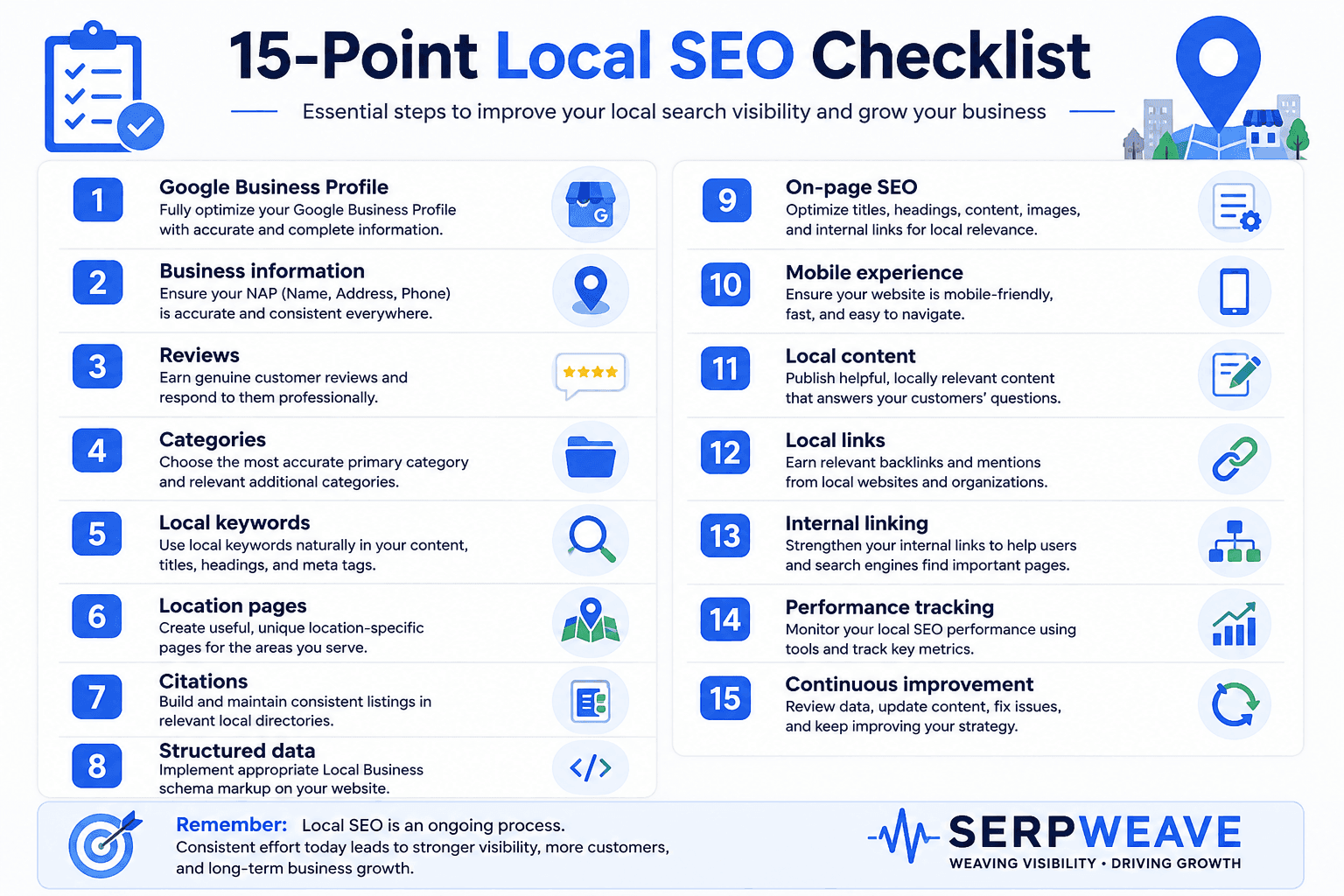
How to Prioritize the 15 Best Practices
If you're overwhelmed by the list, don't try to complete everything in one day. Start with the fundamentals and build outward.
| Priority | Focus | First Action |
|---|---|---|
| 1. Foundation | Google Business Profile & business information | Correct inaccurate or incomplete information. |
| 2. Reputation | Reviews & customer experience | Create a consistent, ethical review-request process. |
| 3. Relevance | Website & local content | Make your services and geographic relevance clear. |
| 4. Authority | Citations, mentions & links | Build relevant business relationships and listings. |
| 5. Measurement | Tracking & improvement | Monitor performance and prioritize the next opportunity. |
You don't need to implement all 15 practices simultaneously. Start with the areas that create the strongest foundation for your business, then use your performance data to determine what to improve next.
These 15 practices provide the foundation for a sustainable Local SEO strategy. But even businesses that follow the fundamentals can make mistakes that limit their results. In the next section, we'll look at the most common Local SEO mistakes to avoid and turn these recommendations into a practical checklist.
Common Local SEO Mistakes to Avoid
Following Local SEO best practices is important, but avoiding common mistakes is just as important. Some businesses spend months creating content and building citations while overlooking basic issues that make their online presence less useful to customers and search engines.
1. Stuffing Keywords Into Your Business Name
Your Google Business Profile should represent your real-world business name. Adding extra keywords or locations simply because you want to rank for them can create an inaccurate profile and may violate Google's guidelines.
Use your actual business name and optimize the legitimate fields available to you instead.
2. Creating Thin Location Pages
Creating dozens of pages where only the city name changes does not automatically create a stronger local presence.
Location pages should exist because they provide useful information for customers in that location. If two pages contain essentially the same content, ask whether both pages genuinely deserve to exist.
3. Buying or Manipulating Reviews
Fake reviews may look like a shortcut, but they undermine customer trust and can violate platform policies. Build your review profile through genuine customer experiences instead.
4. Treating Citations as a Numbers Game
You do not need hundreds of random directory listings simply because someone promises a large number of citations. Prioritize relevant, legitimate sources and keep your important business information accurate.
5. Ignoring the Website
A strong Google Business Profile cannot compensate for a website that is slow, difficult to navigate, poorly organized, or unclear about what the business actually offers.
Your website should support your local presence with useful content, clear service information, strong internal linking, mobile usability, and a sound technical foundation.
6. Publishing Generic AI Content Without Adding Value
AI can help with research, organization, and content production, but simply generating generic articles with city names inserted into them does not create genuine local expertise.
Strong local content should provide useful information, real examples, original insights, practical recommendations, or other value that helps the reader make a decision.
7. Focusing Only on Rankings
A ranking is not the final business objective. A business can rank well and still struggle to generate leads if its website, offer, reviews, contact process, or customer experience is poor.
Monitor visibility alongside meaningful business outcomes such as calls, enquiries, bookings, leads, and sales.
Before investing in another advanced SEO tactic, audit your fundamentals: Google Business Profile, business information, reviews, website usability, important service pages, and conversion paths. Fixing obvious weaknesses often gives you a better foundation for everything else.
Local SEO Checklist
Use this checklist as a simple starting point for your Local SEO campaign. You don't have to complete every task at once. Prioritize the areas that are most relevant to your business and market.
| Task | What to Check |
|---|---|
| Google Business Profile | Profile is claimed, accurate, complete, and represents the real business. |
| Business information | Name, address, phone, website, and hours are accurate. |
| Categories | Primary and additional categories accurately represent the business. |
| Reviews | Business has a legitimate process for earning and responding to reviews. |
| Local keywords | Important pages clearly communicate services and geographic relevance. |
| Location pages | Pages provide genuinely useful, location-specific information. |
| Citations | Important business listings are accurate and relevant. |
| Structured data | Appropriate structured data is implemented accurately where relevant. |
| On-page SEO | Titles, headings, content, internal links, and metadata are optimized. |
| Mobile experience | Website works smoothly and clearly on mobile devices. |
| Local content | Content answers useful questions for the customers you serve. |
| Local authority | Business earns relevant mentions, relationships, and links. |
| Internal linking | Related pages are connected with descriptive, useful anchor text. |
| Performance tracking | Search visibility, traffic, leads, and other meaningful metrics are monitored. |
| Ongoing optimization | Business information, content, reviews, and SEO performance are reviewed regularly. |
How to Measure Local SEO Success
Local SEO performance should be evaluated using more than a single keyword position. Rankings can vary based on location, device, search context, and other factors, so a broader set of measurements provides a more useful picture.
Useful Local SEO Metrics
- Search impressions: How often your pages appear in search results.
- Organic clicks: How much traffic your website receives from search.
- Local visibility: How often your business appears for relevant local searches.
- Google Business Profile interactions: Relevant calls, website visits, directions, or other available interactions.
- Leads and enquiries: Whether search visibility is generating potential customers.
- Conversions: Whether visitors complete meaningful actions.
- Review growth: Whether your legitimate customer-review process is producing ongoing feedback.
Google Search Console can help you understand how your website performs in Google Search, while analytics and conversion tracking can help connect organic visibility with business outcomes.
If you want to explore free tools for monitoring Local SEO, you can also connect this article to SERPWeave's guide on free tools for tracking Local SEO performance.
Frequently Asked Questions About Local SEO Best Practices
What are the most important Local SEO best practices?
The most important Local SEO practices include optimizing your Google Business Profile, maintaining accurate business information, earning genuine customer reviews, using relevant local keywords, creating useful location-specific content, building relevant citations and links, improving website usability, and monitoring performance.
How can I improve my Local SEO quickly?
Start with the fundamentals. Check your Google Business Profile, correct inaccurate business information, review your categories, make sure your website clearly explains your services and location, respond to customer reviews, and fix obvious mobile or technical website issues. These actions create a stronger foundation before moving into more advanced Local SEO work.
Does Google Business Profile help with Local SEO?
Yes. A properly maintained Google Business Profile helps Google understand your business and gives customers important information such as your services, location, hours, contact details, and reviews. It is an important part of a broader Local SEO strategy.
How important are Google reviews for Local SEO?
Reviews can influence both customer trust and local search visibility. Google states that reviews and positive ratings can help businesses stand out and can contribute to local ranking. Businesses should focus on earning genuine reviews rather than manipulating them.
What is NAP consistency in Local SEO?
NAP stands for Name, Address, and Phone number. NAP consistency refers to keeping these core business details accurate and consistent across important online sources such as your website, Google Business Profile, directories, and relevant business listings.
How many local citations does a business need?
There is no universal number of citations every business needs. Instead of pursuing a specific quantity, prioritize legitimate, relevant directories and websites where customers may reasonably expect to find your business. Accuracy and relevance are more useful goals than simply collecting listings.
Should every business create city-specific pages?
No. Location pages are most useful when a business genuinely serves multiple locations and each page provides valuable information for customers in that market. Creating large numbers of nearly identical pages solely to target city keywords can create a poor user experience.
Does local content need to mention a city repeatedly?
No. Local relevance should be communicated naturally. Useful local content should explain the services, products, problems, customers, and geographic context that genuinely matter to the audience. Repeating a city name excessively can make content difficult to read and does not make it more useful.
How long does Local SEO take to work?
There is no universal timeline. Results depend on factors such as competition, website condition, existing authority, market demand, business reputation, and the amount of work being implemented. Some improvements may become visible relatively quickly, while sustainable growth usually requires consistent optimization and monitoring over time.
Is Local SEO different from Google Maps SEO?
Google Maps visibility is an important part of Local SEO, but Local SEO is broader. It can include Google Business Profile optimization, website optimization, local content, citations, reviews, local links, technical SEO, and other activities that help a business become more visible in location-based searches.
Can small businesses do Local SEO themselves?
Yes. Many Local SEO fundamentals can be implemented by a business owner or internal team, particularly Business Profile optimization, review management, basic website improvements, and business-information cleanup. More complex technical, content, competitive, or multi-location strategies may benefit from professional SEO support.
What should I do if my Local SEO rankings suddenly drop?
Start by checking whether your business information changed, whether your Google Business Profile has issues, whether your website has technical problems, and whether competitors have become more visible. Review Google Search Console and other performance data for changes in impressions, clicks, indexing, and organic traffic before making major changes.
Final Thoughts: Build Local SEO as a Long-Term System
The most effective Local SEO strategy isn't based on finding one secret ranking trick. It comes from consistently making your business easier for customers and search engines to understand, trust, and discover.
Start with the fundamentals: maintain an accurate Google Business Profile, keep your business information reliable, earn genuine customer reviews, create useful website content, improve your technical foundation, and build relevant authority around your business.
Then measure what happens.
Use your data to identify which pages need improvement, which searches are generating visibility, which content deserves expansion, and where customers are encountering friction. Local SEO becomes much more powerful when it is treated as an ongoing optimization process rather than a one-time checklist.
If you already have a strong foundation, the next step is to connect your Local SEO efforts with your broader Local SEO strategy, technical optimization, content strategy, and conversion goals.
Need Help Improving Your Local Search Visibility?
Implementing Local SEO consistently can become difficult when you're managing your business at the same time. SERPWeave helps businesses strengthen local visibility through Google Business Profile optimization, local keyword targeting, citation management, review optimization, location-focused content, and search-focused website improvements.
Start With the Fundamentals
You don't need to implement all 15 practices today. Choose the areas with the clearest opportunities, fix your foundation, and build from there.
Google Business Profile → Accurate Information → Reviews → Website → Local Content → Authority → Measurement → Continuous Improvement.
That is the foundation of a sustainable Local SEO strategy.

Rhea Bigcas is an SEO Specialist and the founder of SERPWeave, specializing in local SEO, on-page SEO, technical SEO, and content optimization. With hands-on experience using tools such as Google Search Console, Google Analytics, SEMrush, Ahrefs, and Screaming Frog, she helps businesses identify SEO opportunities and improve their visibility in search results. Through SERPWeave, Rhea shares practical SEO strategies and insights designed to help businesses strengthen their online presence, attract relevant organic traffic, and adapt to the evolving world of traditional and AI-powered search.