
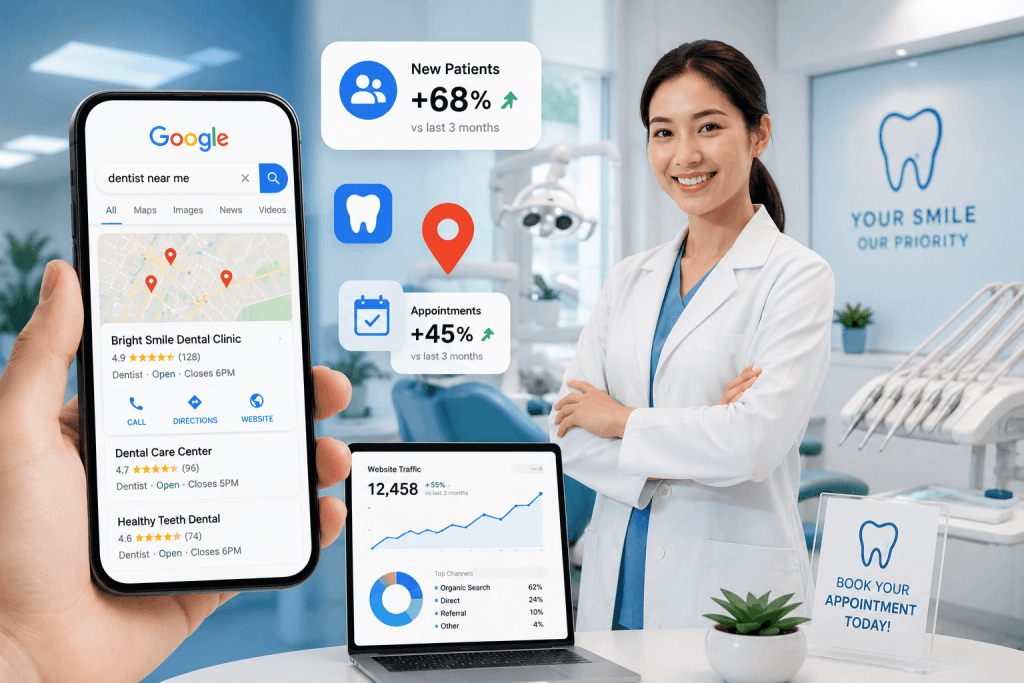
SEO for dentists is the process of optimizing a dental practice's website, Google Business Profile, online reputation, content, and overall digital presence so potential patients can find the practice when searching for dental services on Google.
For a dental practice, appearing when someone searches for a dentist, dental clinic, cosmetic dentist, emergency dentist, or a specific treatment can make a significant difference in patient acquisition. Unlike traditional advertising, SEO can connect your practice with people who are already looking for the services you provide.
But ranking a dental practice is about more than adding the word "dentist" to your website. Dental SEO combines local SEO, keyword research, helpful content, service-page optimization, Google Business Profile optimization, technical SEO, reviews, backlinks, structured data, and conversion optimization.
In this guide, you'll learn how dental SEO works, which strategies matter most, how to optimize your website for high-intent dental searches, and how to turn search visibility into actual patient enquiries and appointments.
Quick Answer: What Is SEO for Dentists?
SEO for dentists is the process of improving a dental practice's online visibility so it can appear more prominently when potential patients search for dentists, dental treatments, and related services on Google. Dental SEO typically includes Google Business Profile optimization, local keyword research, dental service-page optimization, helpful content, technical SEO, reviews, local citations, backlinks, structured data, and conversion-focused website improvements.
The ultimate goal is not simply to increase website traffic. It is to attract qualified patients who are actively looking for dental services and make it easy for them to contact, call, book, or visit the practice.
Key Takeaways
- Dental SEO connects your practice with people actively searching for dental services.
- Google Business Profile optimization is an important part of local visibility for dental practices.
- Your website should have dedicated, useful pages for important dental treatments and services.
- Local keywords help Google understand where your practice operates and which searches are relevant.
- Genuine patient reviews can strengthen trust and support local search visibility.
- Helpful dental content can build topical authority and answer questions potential patients ask before booking.
- Technical SEO, mobile usability, page speed, and structured data provide an important foundation.
- The best dental SEO strategy measures patients, calls, enquiries, and appointments rather than rankings alone.
Table of Contents
- What Is SEO for Dentists?
- Why SEO Matters for Dental Practices
- How Dental SEO Works
- Dental SEO vs. General SEO
- Dental SEO Best Practices
- Common Dental SEO Mistakes
Dental SEO is a specialized form of search engine optimization designed for dentists, dental clinics, and dental practices.
The fundamental principles are similar to traditional SEO, but the strategy needs to account for how patients search for dental care.
A potential patient might search for:
- "dentist near me"
- "dentist in [city]"
- "best dentist near me"
- "emergency dentist"
- "cosmetic dentist"
- "teeth whitening near me"
- "dental implants [city]"
- "root canal dentist near me"
- "pediatric dentist"
- "affordable dentist near me"
Each search represents a slightly different need and level of purchase intent.
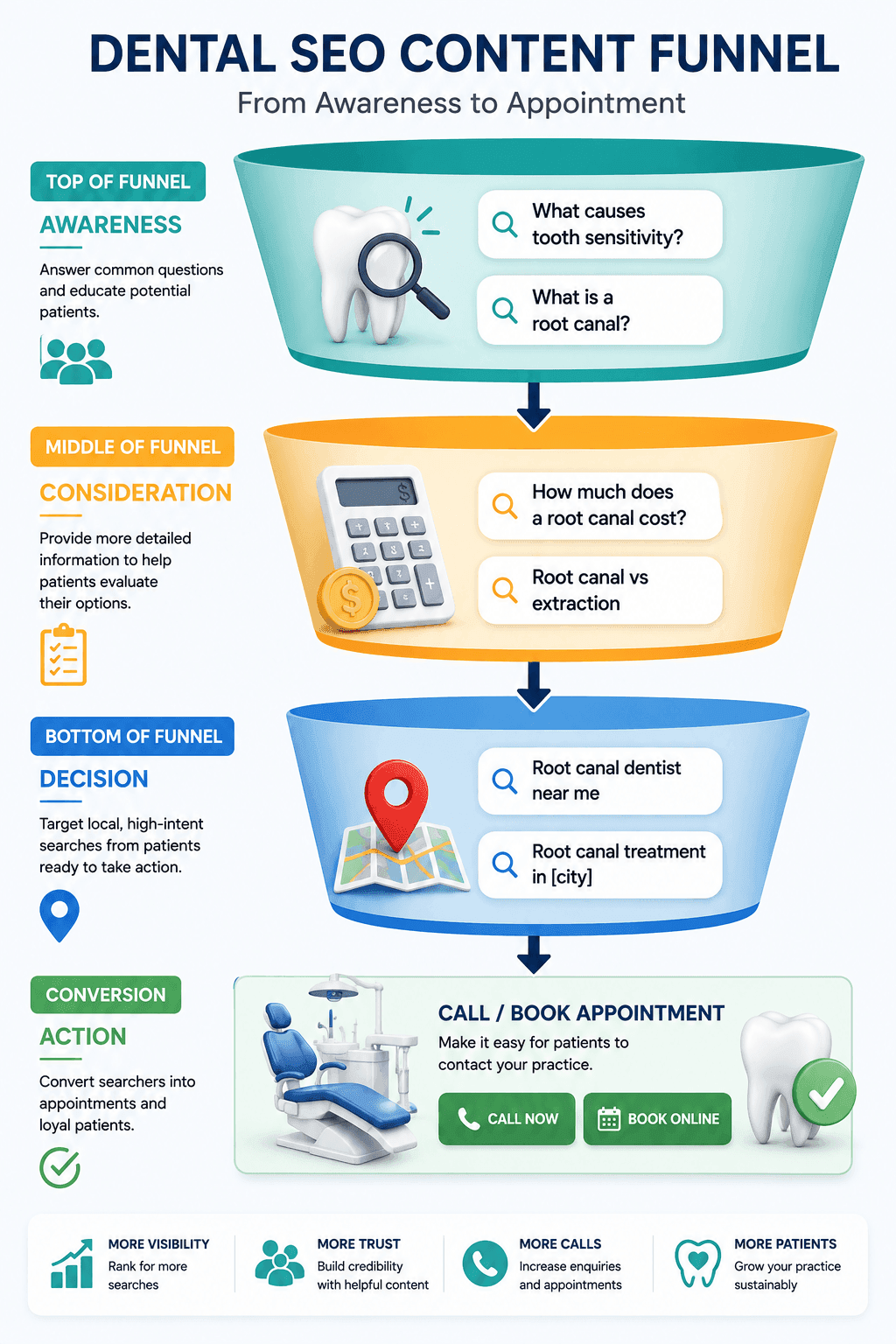
Someone searching for "what causes tooth sensitivity" may still be researching, while someone searching for "emergency dentist near me" may be ready to contact a practice immediately.
A strong dental SEO strategy therefore needs to target different stages of the patient's search journey rather than optimizing every page for the same keyword.
Dental SEO Has Two Major Goals
Successful dental SEO should accomplish two things:
- Increase qualified visibility so the practice appears for searches relevant to its services and location.
- Convert that visibility into patient actions such as phone calls, appointment requests, contact-form submissions, and bookings.
That second goal is often overlooked.
Getting thousands of visitors who are not looking for your services is less valuable than attracting a smaller number of people who are actively searching for a dentist or dental treatment.
Why SEO Matters for Dental Practices
Dental care is highly local and highly trust-driven.
Patients typically want a practice that is convenient to reach, offers the treatment they need, has positive reviews, and appears trustworthy enough to contact.
Search engines have become one of the places where patients evaluate those options.
When someone searches for a dental service, they may encounter:
- Google Maps results
- Google Business Profiles
- Organic website listings
- Review information
- Dental service pages
- Frequently asked questions
- AI-generated search results
Your practice therefore needs more than a website that simply lists your phone number and opening hours.
It needs a digital presence that clearly communicates who you are, where you operate, what treatments you provide, why patients should trust you, and how they can contact you.
This is where dental SEO can become a long-term patient acquisition channel.
Dental SEO should be treated as a patient-acquisition strategy rather than a traffic-generation project. A ranking is valuable only when it helps the right people discover your practice and take the next step toward becoming a patient.
SEO Can Help Dental Practices Attract High-Intent Searches
Consider the difference between these searches:
| Search | Likely Intent |
|---|---|
| "how often should you brush your teeth" | Informational |
| "how much do dental implants cost" | Commercial research |
| "dental implants in [city]" | Service + local intent |
| "best dental implant dentist near me" | High commercial intent |
| "emergency dentist near me" | Urgent service intent |
A comprehensive dental SEO strategy can create content and landing pages that address each of these search behaviors.
How Does Dental SEO Work?
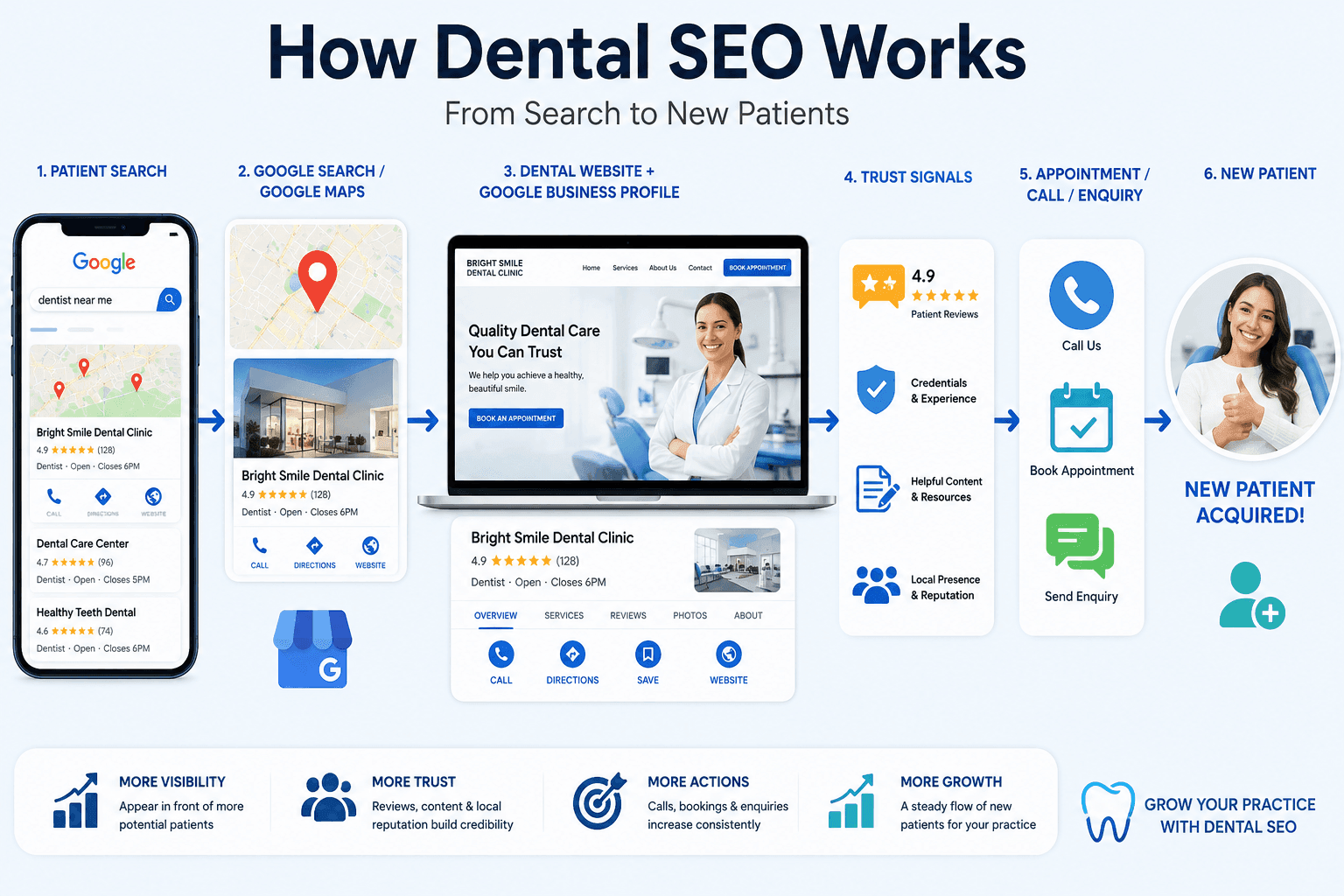
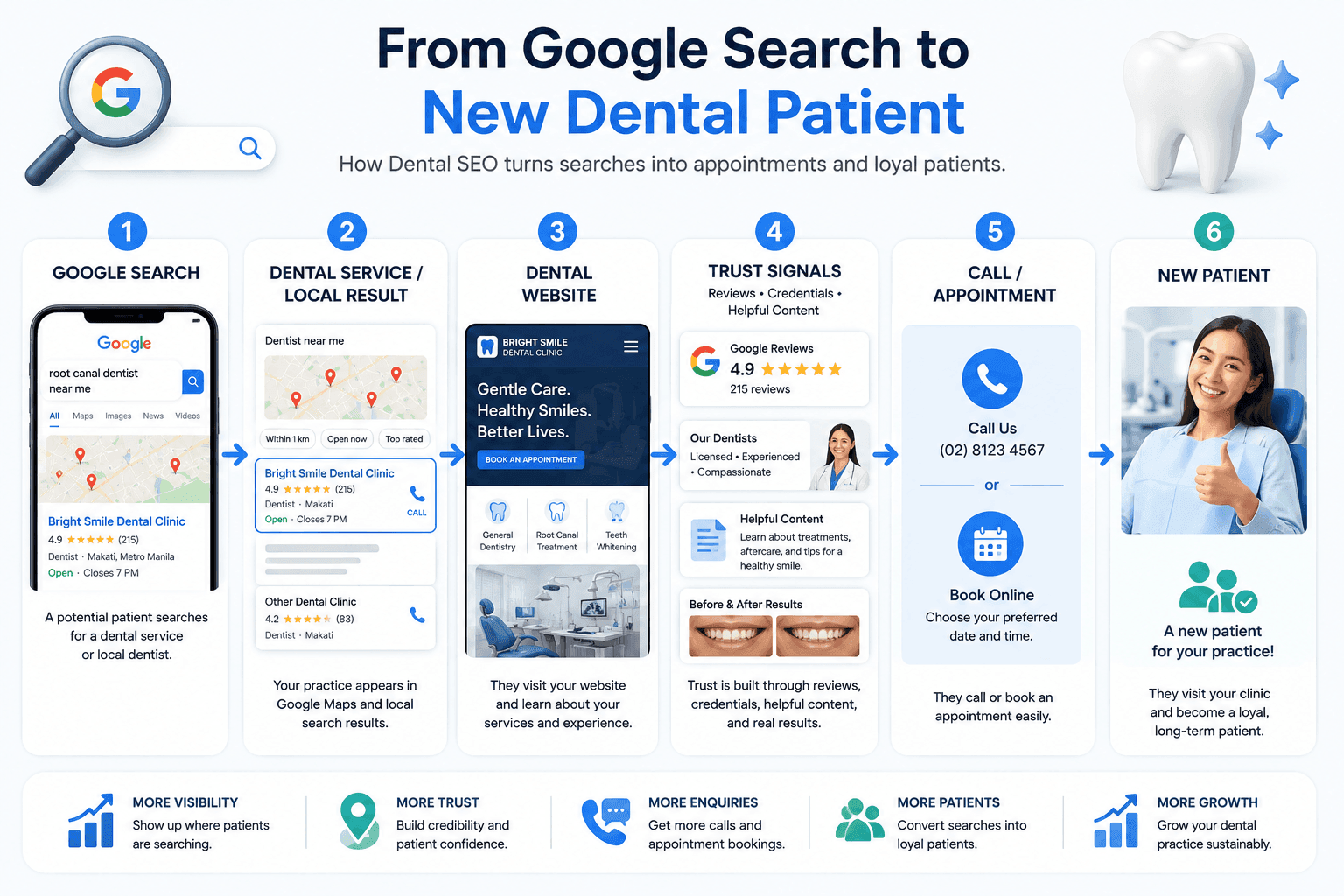
Dental SEO works by improving the signals that help search engines understand your practice, your services, your location, and the usefulness of your website.
Think of the process as several connected layers rather than one isolated optimization task.
1. Search Intent
First, you need to understand what potential patients are actually searching for.
Someone looking for a cosmetic dentist has different needs from someone experiencing a dental emergency. Someone researching Invisalign may need educational information before making an appointment.
Keyword research should therefore consider:
- Dental services
- Treatment keywords
- Location-based searches
- Emergency searches
- Questions patients ask
- Cost-related searches
- Comparison searches
- Informational searches
2. Website Relevance
Your website needs dedicated pages that clearly explain the services you offer.
For example, if a dental practice provides dental implants, Invisalign, teeth whitening, root canal treatment, and emergency dentistry, each important service may deserve a dedicated page rather than being squeezed into one generic "Services" page.
Those pages should explain what the treatment involves, who it may be appropriate for, what patients can expect, and how they can contact the practice.
3. Local Visibility
Because dental practices usually serve specific geographic areas, local SEO is a major part of dental SEO.
Your Local SEO strategy should support the dental practice's visibility through accurate business information, Google Business Profile optimization, local relevance, reviews, citations, and location-focused website content.
">Local SEO strategy should support the dental practice's visibility through accurate business information, Google Business Profile optimization, local relevance, reviews, citations, and location-focused website content.4. Trust and Reputation
Choosing a dentist is a trust-based decision.
Patients want to know that the practice is legitimate, professional, experienced, and capable of providing the treatment they need.
Trust can be supported through:
- Genuine patient reviews
- Professional biographies
- Clear treatment information
- Before-and-after examples where appropriate
- Professional credentials
- Transparent contact information
- Secure website experience
- Helpful patient education
5. Technical SEO
Search engines also need to be able to crawl, understand, and access your website effectively.
Technical SEO can include:
- Mobile usability
- Page speed
- Core Web Vitals
- Site architecture
- Internal linking
- Indexing
- Structured data
- HTTPS security
- Broken-link management
A technically sound website gives your content a stronger foundation for organic visibility.
Dental SEO vs. General SEO: What's Different?
The basic principles of SEO apply to almost every industry, but the strategy should change depending on the business, audience, competition, and search behavior.
Dental practices have several characteristics that make specialized SEO particularly valuable.
| General SEO | Dental SEO |
|---|---|
| May target broad national or international searches. | Often focuses heavily on local patient searches. |
| Keyword strategy varies by industry. | Includes treatments, procedures, symptoms, and dental services. |
| Conversion goals vary. | Common goals include calls, appointment requests, and bookings. |
| Reviews may be useful depending on the business. | Reviews can be especially important for patient trust. |
| Content depends on the industry. | Content often needs to answer patient questions and explain treatments clearly. |
This is why simply applying a generic SEO checklist to a dental website isn't always enough.
The strategy needs to reflect how patients search for dental care and how they decide which practice to contact.
Look at your website navigation from a patient's perspective. Can someone immediately find your main treatments, location, dentist information, reviews, contact details, and appointment option? If not, improving the website experience should be part of your SEO strategy.
What Does a Strong Dental SEO Strategy Include?
A successful dental SEO campaign usually combines several areas rather than relying on one tactic.
| SEO Area | Primary Goal |
|---|---|
| Keyword research | Identify searches used by potential patients. |
| Local SEO | Improve visibility in local search and Google Maps. |
| Google Business Profile | Improve local business information and visibility. |
| Service pages | Target high-intent treatment and service searches. |
| Content strategy | Answer patient questions and build topical authority. |
| Technical SEO | Improve crawling, indexing, performance, and usability. |
| Reviews | Build trust and strengthen the practice's reputation. |
| Local citations | Maintain accurate business information across relevant platforms. |
| Backlinks | Build relevant website authority. |
| Conversion optimization | Turn search visitors into calls and appointment enquiries. |
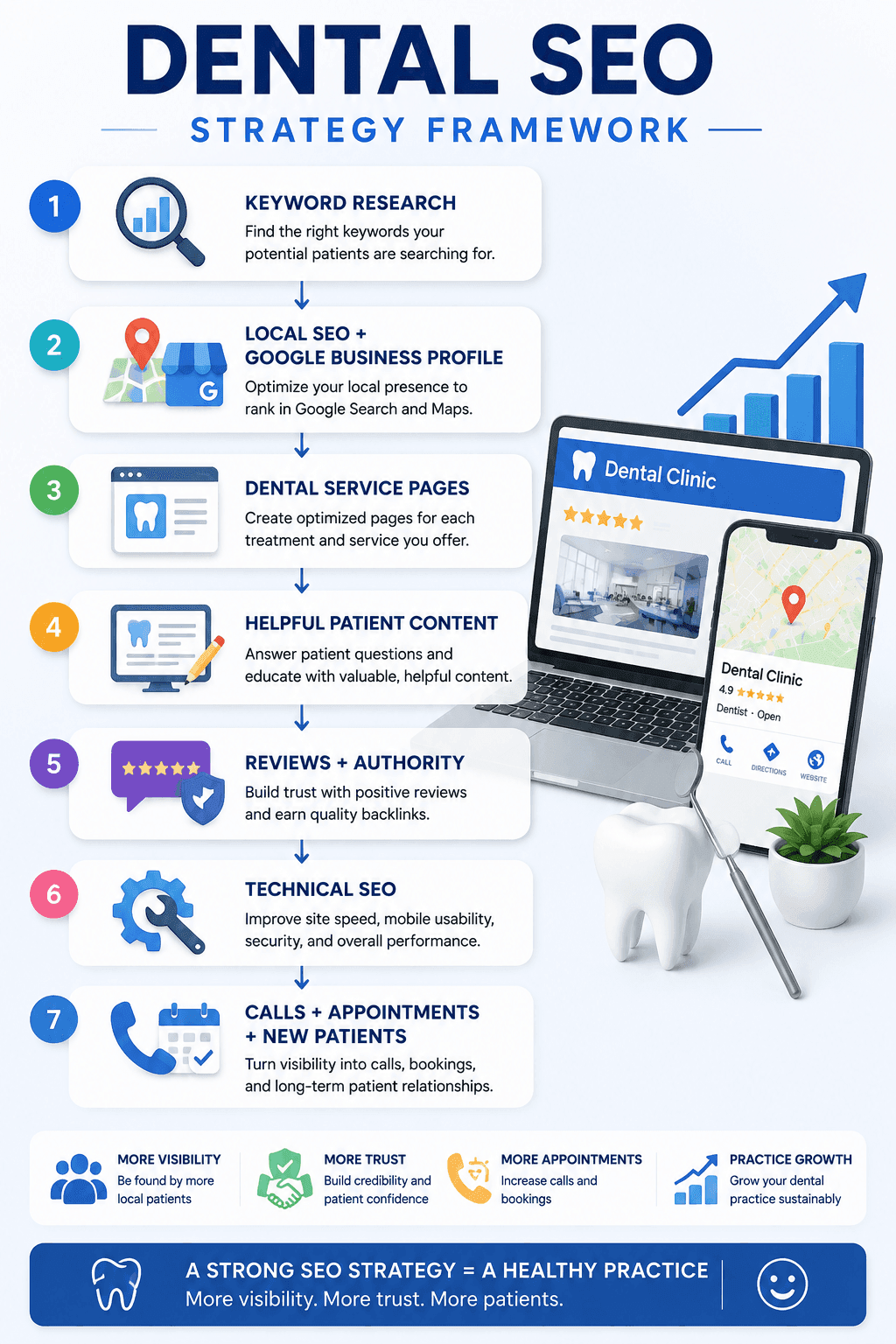
The important point is that these areas support one another. For example, keyword research can identify treatment searches, which can inform service pages, which can then be connected through internal links to educational content and supported by local search optimization.
If you want to understand the broader framework behind this approach, our Local SEO Best Practices guide covers the foundational local search principles that also apply to dental practices.
In the next section, we'll move into the practical part of the strategy: the specific dental SEO practices that can help a practice improve visibility, attract qualified patients, and generate more appointment opportunities.
15 Dental SEO Strategies That Can Help Attract More Patients
Understanding what dental SEO is only gets you started. The next step is putting a strategy in place that connects your website, Google Business Profile, content, reputation, and technical SEO efforts.
Here are 15 practical SEO strategies for dentists that can help improve search visibility and create more opportunities for patient enquiries.
1. Start With Dental Keyword Research
Keyword research should be the foundation of your dental SEO strategy. Before creating or optimizing pages, identify the terms potential patients actually use when searching for your services.
Don't focus only on broad terms such as "dentist". These keywords can be extremely competitive and don't always reveal what the searcher needs.
Instead, build a keyword list around:
- Dental services
- Specific treatments
- Dental problems and symptoms
- Location-based searches
- Emergency dental services
- Cost and pricing questions
- Patient questions
- Commercial comparison searches
For example, a practice offering dental implants could potentially target terms such as:
- dental implants
- dental implants near me
- dental implants in [city]
- dental implant dentist
- how much do dental implants cost
- dental implant consultation
Each keyword should be mapped to the page that best satisfies its search intent.
Common mistake: Trying to optimize the homepage for every dental service and every location. Important treatments deserve focused pages of their own.
2. Optimize Your Google Business Profile
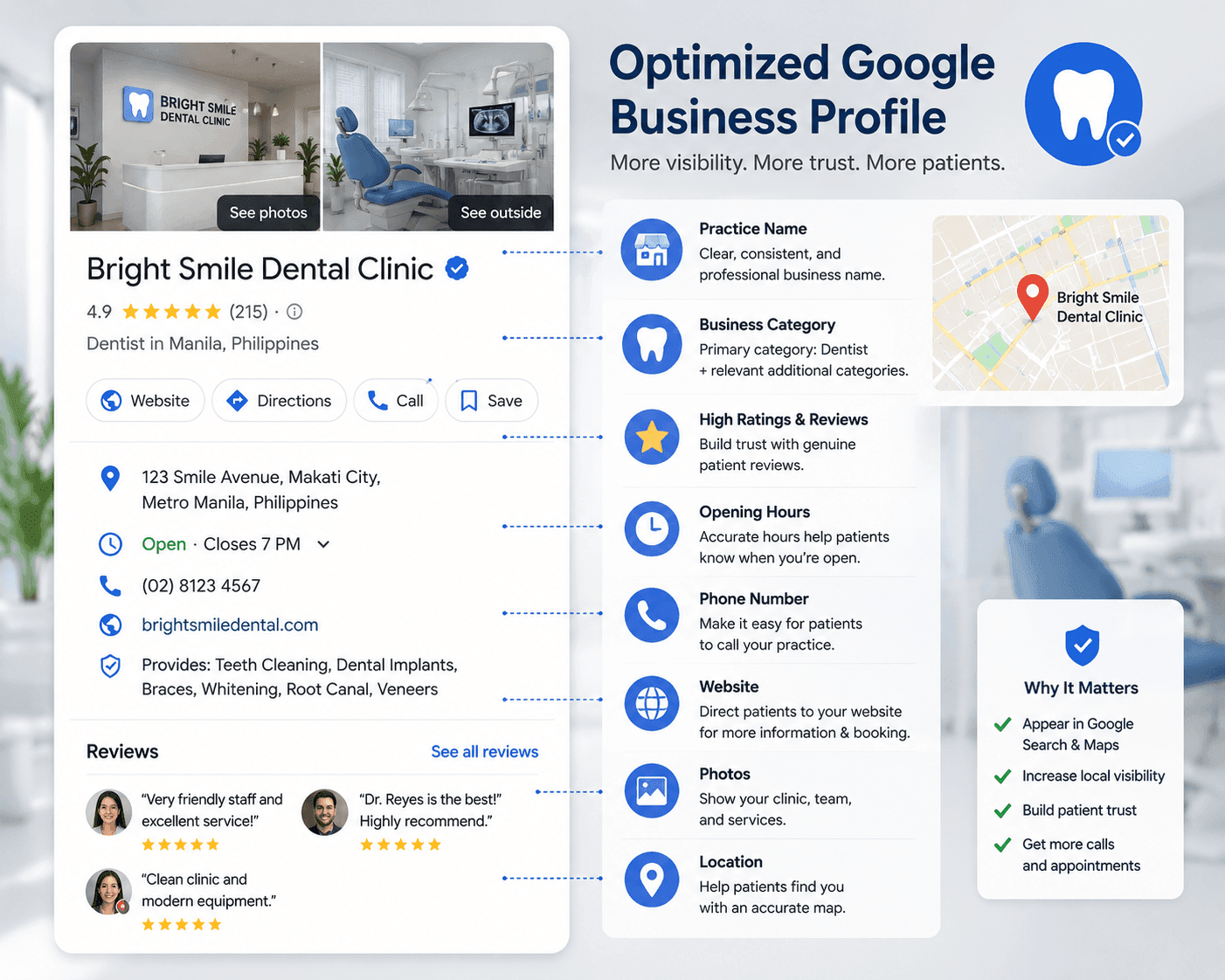
For a dental practice serving a specific geographic area, Google Business Profile optimization should be a major part of the Local SEO strategy.
Your profile should accurately communicate:
- Practice name
- Primary business category
- Relevant additional categories
- Address or service area
- Phone number
- Website
- Opening hours
- Dental services
- Practice photos
Make sure the information matches the real business and remains accurate when details change.
Photos can also help potential patients understand what to expect before contacting the practice. Consider adding appropriate photos of the exterior, reception area, treatment rooms, team, and other parts of the practice that help establish trust.
For a broader explanation of local optimization, you can connect this section to your Local SEO Best Practices guide.
Common mistake: Treating Google Business Profile setup as a one-time task. Your profile should be reviewed and maintained as your practice changes.
3. Create Dedicated Pages for Important Dental Services
One of the strongest opportunities in dental SEO is creating useful pages around the treatments and services your practice actually provides.
Instead of putting every treatment on one generic services page, consider creating dedicated pages for important services such as:
- Dental implants
- Cosmetic dentistry
- Teeth whitening
- Invisalign or clear aligners
- Root canal treatment
- Emergency dentistry
- Dental crowns
- Dental bridges
- Veneers
- Pediatric dentistry
A strong treatment page should answer the questions a potential patient is likely to have before contacting the practice.
A useful dental service page can explain:
- What the treatment is
- Who it may be suitable for
- What the procedure involves
- What patients can expect
- Common questions
- Potential benefits and considerations
- What happens during a consultation
- How to contact the practice
Don't create pages for treatments you don't actually provide just because they have search volume.
Common mistake: Creating short service pages that contain little more than a treatment name, a few sentences, and a contact button.
4. Target Local Keywords Naturally
Dental practices usually depend on patients within a specific geographic area. That makes local keyword targeting an important part of dental website SEO.
Depending on the practice, relevant searches could include:
- dentist in [city]
- dental clinic in [city]
- cosmetic dentist in [city]
- dental implants in [city]
- emergency dentist in [city]
- dentist near [neighborhood]
Use local terminology where it genuinely helps users understand your service area.
Important locations can appear naturally in:
- Page titles
- Headings
- Service-page copy
- Contact information
- Location pages
- Internal links
- Relevant FAQs
Avoid repeating the same city name unnaturally throughout the page.
Common mistake: Keyword stuffing location names into paragraphs, headings, image alt text, and metadata simply to increase keyword frequency.
5. Build Useful Dental Location Pages
If your practice has multiple physical locations or genuinely serves multiple geographic markets, location-specific pages can help organize your website around those markets.
A useful location page should provide information that is genuinely relevant to people in that area.
Depending on your practice, it could include:
- Practice address
- Opening hours
- Available dental services
- Directions
- Parking information
- Local landmarks
- Location-specific FAQs
- Contact information
- Relevant patient information
Each page should have a clear reason for existing.
If you operate only one dental practice, don't create dozens of near-identical pages for every city surrounding your clinic. Focus on the geographic areas you legitimately serve.
Common mistake: Publishing doorway-style pages with almost identical content and only changing the location name.
6. Create Helpful Content Around Patient Questions
Patients often search for information before they are ready to schedule an appointment.
That creates an opportunity for dental practices to publish helpful educational content that answers genuine questions and introduces potential patients to their expertise.
Examples include:
- How long does teeth whitening last?
- How do dental implants work?
- What should you do after a tooth extraction?
- How long does a root canal take?
- What are the signs you may need a dental crown?
- How often should you visit the dentist?
- What is the difference between veneers and crowns?
The goal isn't to publish content simply because a keyword has search volume.
The goal is to create the most useful answer for the person asking the question.
For broader content strategy guidance, you can also connect this section to SERPWeave's SEO Content Strategy service.
Common mistake: Publishing generic articles that could have been written for any dental practice without adding meaningful expertise, examples, or patient-focused information.
7. Optimize Your Dental Website's On-Page SEO
Every important page on your dental website should have a clear purpose and be optimized around the search intent it is designed to satisfy.
Review important on-page elements such as:
- Title tags
- H1 headings
- H2 and H3 headings
- Meta descriptions
- URL structure
- Internal links
- Image alt text
- Service content
- Calls to action
For example, a page targeting "dental implants in [city]" should clearly explain dental implant services and the location served. It shouldn't simply repeat the target phrase throughout the page.
Use descriptive headings and natural language so both patients and search engines can understand the page.
Common mistake: Optimizing every important page around the exact same keyword. Give each page a distinct search purpose.
8. Build a Strong Technical SEO Foundation
Even excellent dental content can struggle if search engines have difficulty crawling or understanding the website.
Important technical SEO areas include:
- Indexability
- XML sitemap configuration
- Robots.txt
- Canonical URLs
- Mobile usability
- Page speed
- Core Web Vitals
- Broken links
- Redirects
- HTTPS security
- Website architecture
Technical SEO is particularly important when a dental website has been redesigned, migrated, expanded, or built using a large number of plugins and scripts.
If you discover technical problems that affect crawling, indexing, or performance, they should be addressed before investing heavily in additional content.
You can naturally connect this section to SERPWeave's Technical SEO services for readers who need more advanced implementation.
Common mistake: Assuming technical SEO only matters for large websites. Small dental websites can also have indexing, speed, mobile, and architecture problems.
9. Use Appropriate Structured Data
Structured data can help search engines better understand the information presented on your dental website.
Depending on the page and implementation, relevant structured data may help describe entities such as:
- Local business information
- Organization details
- Services
- Locations
- Frequently asked questions where eligible
The markup should accurately represent the content on the page and should not be used to add information that isn't supported by the visible content.
Structured data is not a shortcut to higher rankings. Think of it as a way of communicating information more clearly to search engines.
Common mistake: Adding irrelevant or misleading schema simply because a particular markup type appears attractive for search visibility.
10. Build a Consistent System for Earning Genuine Reviews
Reviews are especially important for dental practices because choosing a dentist involves a significant amount of trust.
Potential patients may look at reviews before deciding whether to visit a practice, so your reputation can influence both search behavior and conversion decisions.
Create a simple process for requesting honest feedback from real patients after appropriate interactions.
A review process could include:
- Provide a positive patient experience.
- Follow up appropriately after the visit.
- Ask for an honest review.
- Make the review process easy to access.
- Respond professionally to reviews.
Don't buy reviews or attempt to manufacture positive feedback.
Negative reviews should also be handled professionally. A calm, respectful response can show prospective patients that the practice takes feedback seriously.
Don't build your review strategy around getting five-star ratings at any cost. Build it around delivering experiences that patients genuinely want to talk about.
Common mistake: Asking patients to leave a review without providing a simple process or convenient way to do it.
11. Maintain Relevant Local Citations
Local citations are mentions of your dental practice's business information across other websites and platforms.
These can include:
- Local business directories
- Dental industry directories
- Professional associations
- Local organizations
- Chambers of commerce
- Relevant healthcare directories
The goal should be accuracy and relevance rather than collecting the largest possible number of listings.
Review important listings periodically to make sure the practice name, address, phone number, website, and other key information remain accurate.
Common mistake: Paying for large batches of low-quality directory submissions simply to increase citation volume.
12. Earn Relevant Backlinks and Local Mentions
Backlinks are links from other websites to your website. Relevant, trustworthy links can help search engines discover your content and can contribute to the authority of your website.
For dental practices, potential opportunities can include:
- Professional dental organizations
- Local business organizations
- Community organizations
- Local publications
- Healthcare resources
- Dental suppliers and partners
- Local events
Focus on earning links because your practice has something useful or noteworthy to contribute—not simply because another website has a high authority metric.
Examples of link-worthy assets could include original research, useful patient resources, expert commentary, community initiatives, or genuinely valuable educational content.
Common mistake: Buying large numbers of unrelated backlinks because they promise fast ranking improvements.
13. Make the Dental Website Mobile-Friendly
Potential patients may search for a dentist from a smartphone while traveling, experiencing discomfort, comparing practices, or trying to schedule an appointment.
Your mobile website should make those actions easy.
Check whether visitors can quickly:
- Read your content
- Find your phone number
- See your location
- Open directions
- View treatment information
- Request an appointment
- Navigate between pages
- Complete forms
Large images, unnecessary scripts, intrusive pop-ups, and complicated navigation can make the mobile experience frustrating.
Common mistake: Treating mobile optimization as simply making the desktop layout responsive. The entire patient journey should be easy to complete on a smaller screen.
14. Optimize Your Website for Patient Conversions
SEO can bring visitors to your website, but your website still needs to convince them to take the next step.
For a dental practice, useful conversion actions may include:
- Calling the practice
- Requesting an appointment
- Completing a contact form
- Requesting a consultation
- Getting directions
- Sending an enquiry
Make these actions easy to find.
Consider adding clear calls to action such as:
- Book an Appointment
- Call Our Dental Practice
- Request a Consultation
- Contact the Dental Team
- Get Directions
Place relevant calls to action throughout the website instead of forcing visitors to search for a contact page.
Common mistake: Measuring SEO success entirely by traffic while failing to track whether visitors actually contact the practice.
15. Prepare Your Dental Content for AI Search
Patients are increasingly using AI-powered search experiences and conversational tools to research businesses, services, treatments, and questions.
This creates another reason to focus on clear, useful, trustworthy content.
Rather than writing content specifically to "trick" AI systems, focus on making your website easy for both traditional search engines and AI-powered systems to understand.
Useful practices include:
- Answer common patient questions clearly.
- Use descriptive headings.
- Provide accurate information.
- Clearly identify your practice and services.
- Maintain consistent business information.
- Demonstrate relevant expertise.
- Use structured content where appropriate.
- Connect related pages with useful internal links.
- Keep important information current.
This approach supports both traditional SEO and the broader goal of making your practice's information understandable across modern search experiences.
For a deeper look at optimizing content for AI-driven discovery, you can connect this section to SERPWeave's AI Search Optimization service.
AI search optimization should not replace traditional SEO fundamentals. Strong technical SEO, helpful content, accurate business information, relevant authority, and a trustworthy website remain the foundation.
What Should Dentists Prioritize First?
If you're starting dental SEO from scratch, don't try to implement every strategy simultaneously.
Start with the areas most likely to create a strong foundation.
| Priority | Focus Area | First Action |
|---|---|---|
| 1 | Google Business Profile | Make sure the profile is accurate, complete, and properly categorized. |
| 2 | Website foundation | Make sure the site is mobile-friendly, fast, crawlable, and easy to navigate. |
| 3 | Dental service pages | Create useful pages for your most important treatments. |
| 4 | Local SEO | Strengthen local relevance, business information, reviews, and citations. |
| 5 | Content | Answer questions potential patients ask before choosing a dentist. |
| 6 | Authority | Earn relevant links, mentions, and professional recognition. |
| 7 | Conversion tracking | Measure calls, enquiries, bookings, and other meaningful actions. |
This order gives you a practical starting point without trying to solve every SEO issue at the same time.
Once the foundation is established, you can use performance data to identify which services, locations, pages, and search opportunities deserve additional investment.
How Long Does Dental SEO Take to Work?
There is no guaranteed timeline for dental SEO results.
The time required can depend on factors such as:
- How competitive the local market is
- The current strength of the website
- The practice's existing online authority
- The quality of existing content
- The practice's review profile
- Technical issues on the website
- Competitor activity
- The consistency of SEO implementation
Some improvements can be noticed sooner than others. For example, correcting inaccurate information or fixing technical problems may produce different outcomes from building long-term authority through content and links.
Instead of expecting an instant ranking increase, treat dental SEO as an ongoing growth strategy.
Monitor search impressions, organic traffic, local visibility, calls, enquiries, and appointments to understand whether your investment is producing meaningful results.
The best dental SEO campaign isn't necessarily the one that produces the biggest traffic increase. It is the one that consistently attracts the right potential patients and creates measurable opportunities for the practice.
Now that we've covered the core strategies, the final section will bring everything together with the most common dental SEO mistakes, a practical checklist, measurement guidance, frequently asked questions, and a clear next step for dental practices looking to improve their search visibility.

Rhea Bigcas is an SEO Specialist and the founder of SERPWeave, specializing in local SEO, on-page SEO, technical SEO, and content optimization. With hands-on experience using tools such as Google Search Console, Google Analytics, SEMrush, Ahrefs, and Screaming Frog, she helps businesses identify SEO opportunities and improve their visibility in search results. Through SERPWeave, Rhea shares practical SEO strategies and insights designed to help businesses strengthen their online presence, attract relevant organic traffic, and adapt to the evolving world of traditional and AI-powered search.