
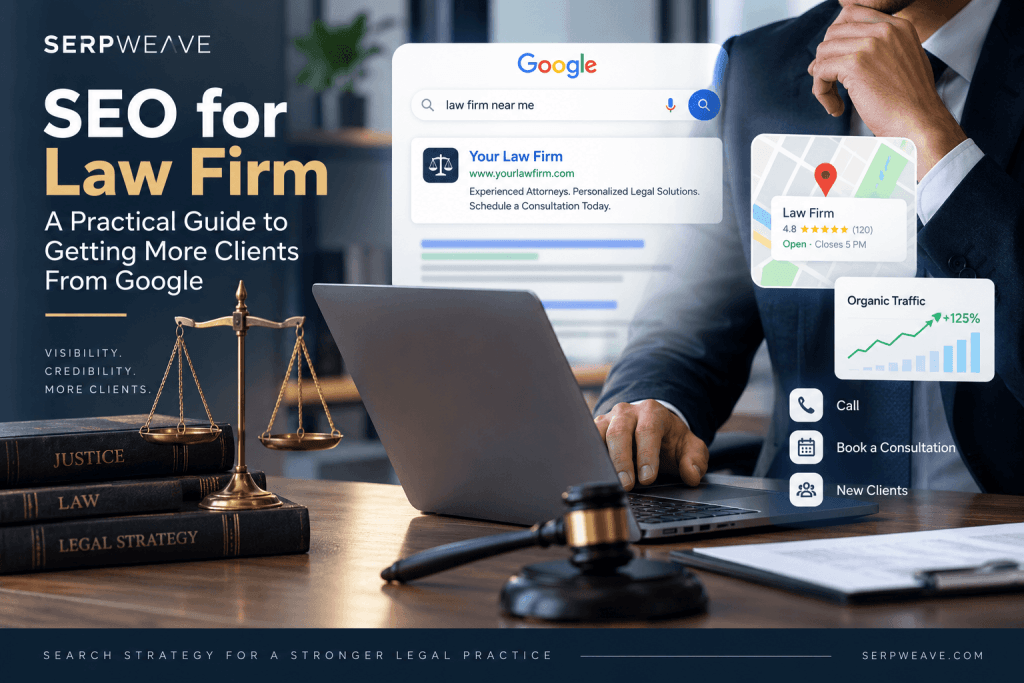
SEO for law firm is the process of improving a law firm's website and online presence so potential clients can find the firm when they search for legal services on Google and other search platforms.
For many people, searching online is one of the first steps they take when they need a lawyer. They may search for a specific practice area, a lawyer near them, or an answer to a legal problem before deciding which firm to contact.
That makes SEO more than a traffic strategy for law firms. Done properly, it can help connect the right people with the right legal service at the moment they are actively looking for help.
Table of Contents
- What Is SEO for a Law Firm?
- Why SEO Matters for Law Firms
- 1. Start With Legal Keyword Research
- 2. Build Strong Practice-Area Pages
- 3. Invest in Local SEO and Google Business Profile
- 4. Create Helpful Legal Content
- 5. Strengthen On-Page SEO
- 6. Fix Technical SEO Problems
- 7. Build Authority and Trust
- 8. Prepare for AI Search
- Common Law Firm SEO Mistakes
- How to Measure Law Firm SEO
- Law Firm SEO Checklist
- Frequently Asked Questions
- Final Thoughts
What Is SEO for a Law Firm?
Law firm SEO is a combination of website optimization, content strategy, local search optimization, technical improvements, and authority-building activities designed to increase a firm's visibility for relevant searches.
For example, a personal injury firm may want to appear for searches such as:
- personal injury lawyer near me
- car accident lawyer in [city]
- best personal injury attorney
- what should I do after a car accident?
A family law practice may instead target searches related to divorce, child custody, adoption, or family law attorneys in its service area.
The important point is that SEO should match what potential clients actually need. Ranking for a high-volume keyword is not particularly useful if the visitors have no reason to hire the firm.
Google's guidance similarly emphasizes creating helpful, reliable, people-first content rather than content created primarily to manipulate search rankings. Google's people-first content guidance is a useful reference when developing a law firm's content strategy.
Why SEO Matters for Law Firms
Legal services are often highly competitive in search results. A firm may have excellent attorneys and years of experience, but prospective clients cannot consider the firm if they cannot find it.
A strong SEO strategy can help a law firm:
- Increase visibility for relevant legal searches
- Attract potential clients searching for specific services
- Generate more qualified website traffic
- Improve visibility in local search and Google Maps
- Build credibility through useful educational content
- Create a consistent source of organic leads
- Reduce reliance on paid advertising for every new inquiry
SEO also allows firms to address different stages of the client journey. Someone searching for “divorce lawyer near me” has a different intent from someone searching for “how long does a divorce take?” Both searches can be valuable, but they should be handled with different types of content.
1. Start With Legal Keyword Research
Effective law firm SEO starts with understanding how potential clients search.
Instead of choosing keywords based only on search volume, consider three things:
- What legal service does the search represent?
- Where is the potential client located?
- What does the person expect to find?
For example, “criminal lawyer” is broad, while “criminal defense lawyer in Miami” is more specific and location-focused. A search such as “what happens at a first DUI court hearing?” represents an informational need that may be better answered through an educational article.
Group keywords by practice area and intent rather than creating one page for every minor keyword variation. This creates a more useful website structure and reduces the risk of producing thin or repetitive pages.
2. Build Strong Practice-Area Pages
Your main practice-area pages should clearly explain what the firm handles and who the service is for.
A strong practice-area page should make it easy for a prospective client to understand:
- What type of legal matter the firm handles
- Who the service is intended for
- What situations may require legal assistance
- What the general process may involve
- Why someone may consider contacting the firm
- How to take the next step
For example, instead of having one generic “Legal Services” page, a firm may create dedicated pages for personal injury, family law, criminal defense, estate planning, immigration, or business law when those services are genuinely offered.
Each page should provide substantial information rather than simply repeating the same template with a different city or keyword.
3. Invest in Local SEO and Google Business Profile
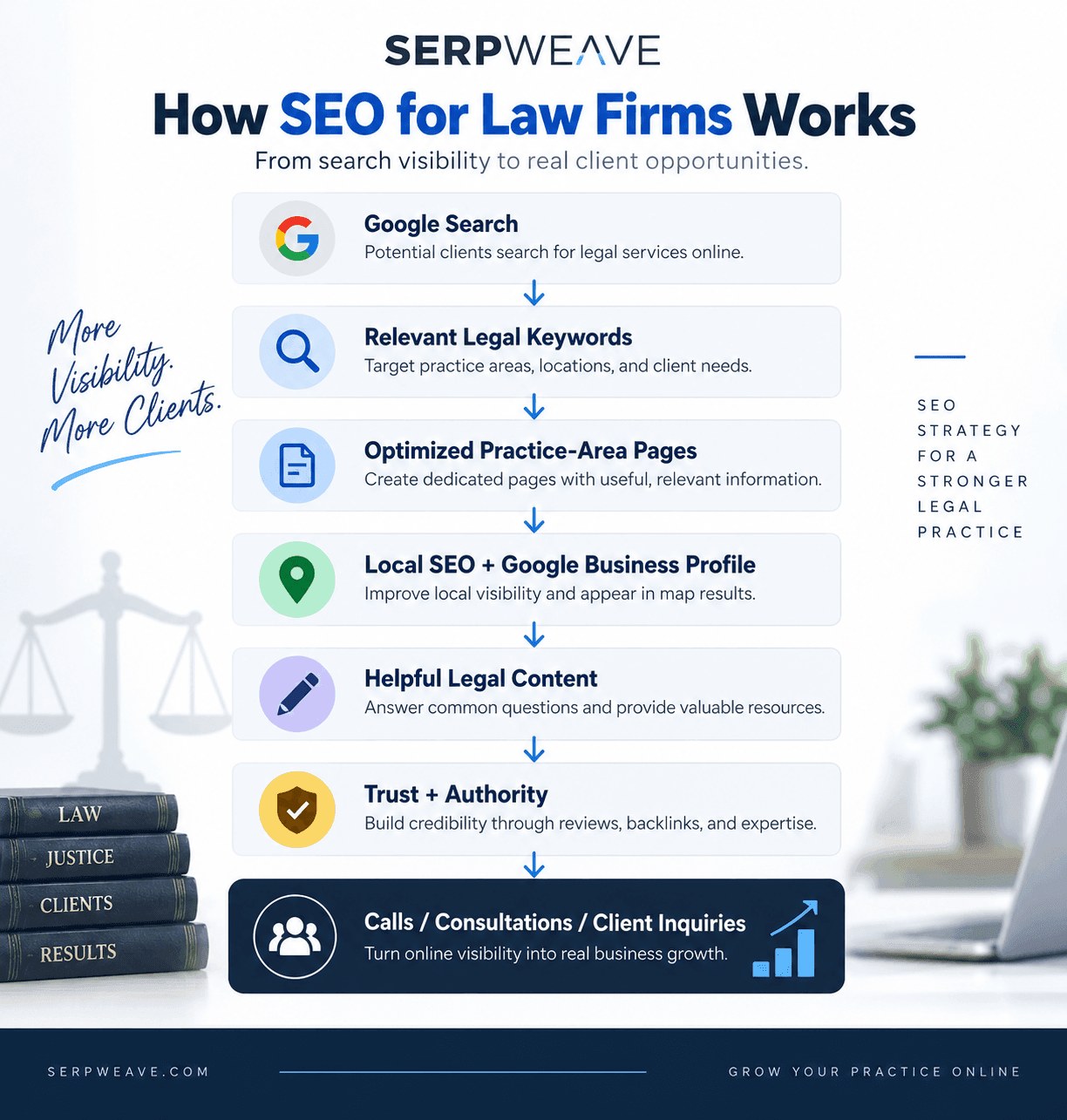
For firms serving specific cities or geographic areas, local SEO can be one of the most important parts of the strategy.
Potential clients frequently use searches that include a location or phrases such as “near me.” A law firm should therefore make its location, service areas, practice areas, and contact information clear across its online presence.
This includes optimizing the firm's Google Business Profile, maintaining accurate business information, collecting genuine client reviews, adding relevant photos, and keeping important business details current.
SERPWeave's Local SEO and Google Business Profile Optimization service can support firms that need a more structured approach to local search visibility.
Google explains that local results are primarily influenced by factors including relevance, distance, and prominence. Its official guidance on how local results are ranked is worth reviewing when optimizing a firm's local presence.
4. Create Helpful Legal Content
Content marketing can help law firms answer questions before a potential client is ready to make contact.
Useful topics can include:
- Common questions about a specific legal issue
- What someone should do after a legal incident
- What documents may be relevant to a legal matter
- General explanations of legal processes
- Differences between related legal services
- Questions clients frequently ask attorneys
The goal is not to publish articles simply because a keyword has search volume. The content should provide a genuinely useful answer and make it clear when professional legal advice may be appropriate.
A structured SEO content strategy can help organize these topics into related content clusters rather than treating every blog post as an isolated page.
Legal content also requires particular care. Laws and procedures can vary by jurisdiction and change over time, so firms should review legal content for accuracy and keep important information current.
5. Strengthen On-Page SEO
Once the content is useful, the page itself should make the topic easy for both users and search engines to understand.
Important on-page elements include:
- Descriptive title tags
- Clear H1 and H2 headings
- Relevant and natural keyword usage
- Descriptive URLs
- Helpful meta descriptions
- Internal links between related pages
- Descriptive image alt text
- Clear calls to action
Internal linking is especially useful for law firms because practice-area pages, location pages, FAQs, and educational articles often cover closely related topics.
For example, an article explaining the basics of a personal injury claim could naturally link to the firm's personal injury service page. This helps readers find the next relevant resource while strengthening the relationship between related pages.
Google's SEO Starter Guide provides additional guidance on creating search-friendly website content and structure.
6. Fix Technical SEO Problems
Great legal content cannot perform at its full potential if search engines struggle to crawl, index, or understand the website.
Technical SEO should address areas such as:
- Website crawlability
- Indexation
- Mobile usability
- Page speed
- Core Web Vitals
- Broken links and redirects
- Canonical URLs
- XML sitemaps
- Structured data
- HTTPS and website security
Law firms with older websites should also check whether important practice-area pages are actually accessible to search engines and linked properly within the site's architecture.
Technical SEO services can help identify and resolve technical issues that may limit a site's search visibility.
Google's developer SEO documentation also emphasizes areas such as crawlability, accessibility, mobile usability, and website performance when building search-friendly websites.
7. Build Authority and Trust
People choosing a lawyer are making an important decision. Trust therefore matters just as much as visibility.
Your website should make it easy for prospective clients to understand who is behind the firm and why the firm is qualified to handle the relevant type of matter.
Useful trust signals can include:
- Attorney biographies and credentials
- Relevant professional experience
- Practice-area expertise
- Accurate office and contact information
- Genuine client reviews where permitted
- Helpful educational resources
- Clear authorship and content-review information
- Links to appropriate professional organizations or authoritative resources
Law firm marketing also has an important ethical dimension. Advertising rules differ by jurisdiction, so firms should review their applicable professional-conduct requirements before making claims about results, expertise, specialization, testimonials, or comparative superiority.
The American Bar Association's Model Rules covering lawyer advertising and communications provide useful background, although individual state or jurisdictional rules may impose additional requirements.
The ABA also provides guidance on attorney advertising ethics in the digital age, which is particularly relevant as firms expand their websites, social profiles, reviews, and digital marketing efforts.
8. Prepare for AI Search
Search behavior is changing. Potential clients may still use traditional Google results, but they may also encounter AI-generated answers and use AI assistants to research legal topics, compare options, or identify providers.
This does not mean law firms should abandon traditional SEO. Instead, the fundamentals become even more important.
AI-friendly content should be:
- Clear and easy to understand
- Organized around real questions
- Specific rather than vague
- Supported by trustworthy information
- Easy to extract and summarize accurately
- Connected to relevant entities, services, and locations
- Consistent with information published elsewhere about the firm
Answer-first sections, descriptive headings, concise explanations, FAQs, strong internal linking, structured data, and clear entity information can all contribute to a website that is easier for modern search systems to interpret.
For firms that want to prepare for these changes, AI Search Optimization focuses on improving visibility across emerging AI-powered search experiences while maintaining a strong traditional SEO foundation.
Common Law Firm SEO Mistakes
Some SEO problems are caused not by a lack of effort, but by focusing on the wrong things.
1. Targeting only broad keywords
Broad terms may have significant search volume but can be extremely competitive and may not clearly indicate client intent.
2. Creating dozens of nearly identical location pages
Changing the city name on an otherwise identical page does not automatically create valuable local content. Location pages should provide genuinely useful information relevant to the area.
3. Publishing thin legal articles
Short articles written solely to target keywords rarely provide enough value for users with serious legal questions.
4. Ignoring Google Business Profile
A firm can have a strong website while missing valuable local visibility because its business profile is incomplete, inaccurate, or poorly maintained.
5. Making unsupported claims
Statements about being the “best,” guaranteeing outcomes, or promising specific results can create both credibility and compliance concerns. Marketing claims should be accurate and appropriate for the firm's jurisdiction.
Review-related claims also deserve care. The FTC's guidance on consumer reviews and testimonials explains requirements surrounding certain review and testimonial practices in the United States.
How to Measure Law Firm SEO
Rankings are useful, but they should not be the only measure of success.
A law firm should also monitor whether SEO is producing meaningful business outcomes.
Useful metrics include:
- Organic traffic
- Organic impressions
- Relevant keyword visibility
- Clicks from Google Search
- Google Business Profile interactions
- Phone calls
- Contact-form submissions
- Consultation requests
- Qualified leads
- Leads generated by specific practice areas
The most valuable question is not simply, “Did we rank higher?” It is “Did our increased visibility help more qualified people find and contact the firm?”
Law Firm SEO Checklist
Use this checklist as a practical starting point:
- ✓ Identify your highest-value practice areas
- ✓ Research service, location, and question-based keywords
- ✓ Create dedicated pages for important legal services
- ✓ Optimize your Google Business Profile
- ✓ Keep business information accurate and consistent
- ✓ Build useful location-specific content where appropriate
- ✓ Publish genuinely helpful legal resources
- ✓ Optimize titles, headings, URLs, and internal links
- ✓ Improve website speed and mobile usability
- ✓ Review crawlability and indexation
- ✓ Strengthen attorney bios and trust information
- ✓ Follow applicable legal advertising requirements
- ✓ Monitor organic traffic and qualified leads
- ✓ Review and update important content regularly
- ✓ Structure content so it can be understood by modern search systems
Frequently Asked Questions
What is SEO for law firms?
SEO for law firms is the process of improving a legal practice's website and online presence so it can appear more prominently for relevant searches related to its legal services and locations. It can include keyword research, content, local SEO, technical optimization, internal linking, and authority-building.
How long does SEO for a law firm take?
SEO is a long-term strategy, and results vary based on competition, website condition, authority, location, content quality, and the firm's starting position. Some improvements can appear relatively quickly, while stronger organic visibility typically requires consistent optimization over time.
What keywords should a law firm target?
Law firms should prioritize keywords that closely match their practice areas, locations, and prospective clients' needs. Service-specific and location-specific searches are often more valuable than broad keywords because they can indicate stronger relevance and intent.
Is local SEO important for law firms?
Yes. Local SEO can be especially important for firms serving specific cities or geographic areas. Optimizing local business information, relevant website content, reviews, and location signals can help improve visibility for searches from potential clients in the firm's service area.
Final Thoughts
Effective law firm SEO is not about adding a few keywords to a website and waiting for rankings to appear. It is about building a search presence that helps potential clients find accurate, useful information and understand what the firm can help them with.
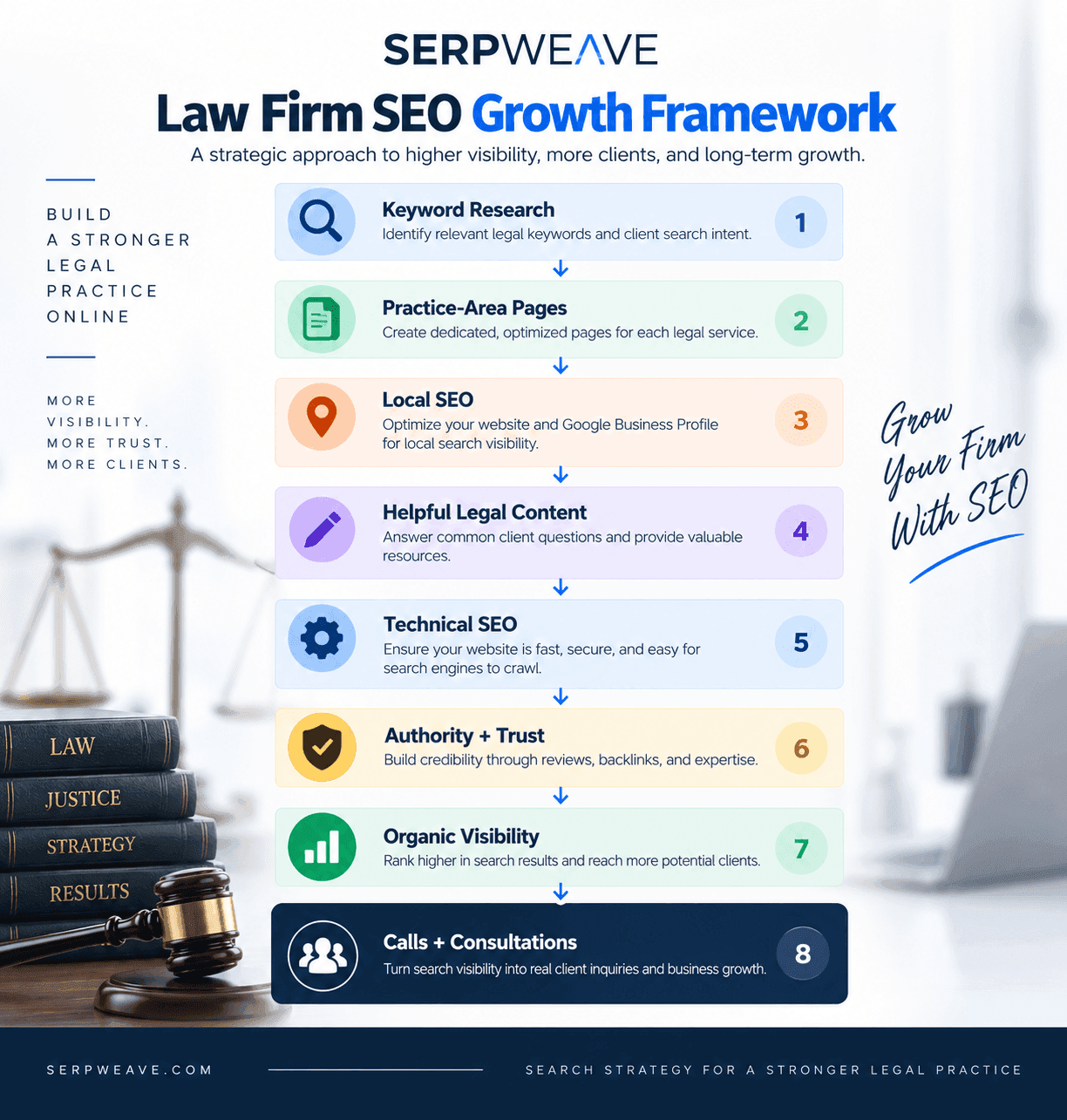
The strongest approach combines search intent, practice-area content, local SEO, Google Business Profile optimization, technical SEO, trust signals, and consistent measurement.
SERPWeave helps businesses build sustainable search visibility through SEO strategies that combine local SEO, technical optimization, content strategy, and modern search visibility. For a law firm, the right strategy should be tailored to its practice areas, geographic market, competition, website, and business goals rather than based on a generic checklist alone.
If you are ready to evaluate where your website currently stands and identify the highest-priority opportunities, you can book a strategy call with SERPWeave.
Note: This article provides general SEO and digital marketing information. It is not legal or professional-conduct advice. Law firms should consult the applicable rules and professional advisers in their jurisdiction before making advertising or marketing claims.

Rhea Bigcas is an SEO Specialist and the founder of SERPWeave, specializing in local SEO, on-page SEO, technical SEO, and content optimization. With hands-on experience using tools such as Google Search Console, Google Analytics, SEMrush, Ahrefs, and Screaming Frog, she helps businesses identify SEO opportunities and improve their visibility in search results. Through SERPWeave, Rhea shares practical SEO strategies and insights designed to help businesses strengthen their online presence, attract relevant organic traffic, and adapt to the evolving world of traditional and AI-powered search.